Article
Why ChatGPT Hedges Every Answer — and How to Get a Straight One
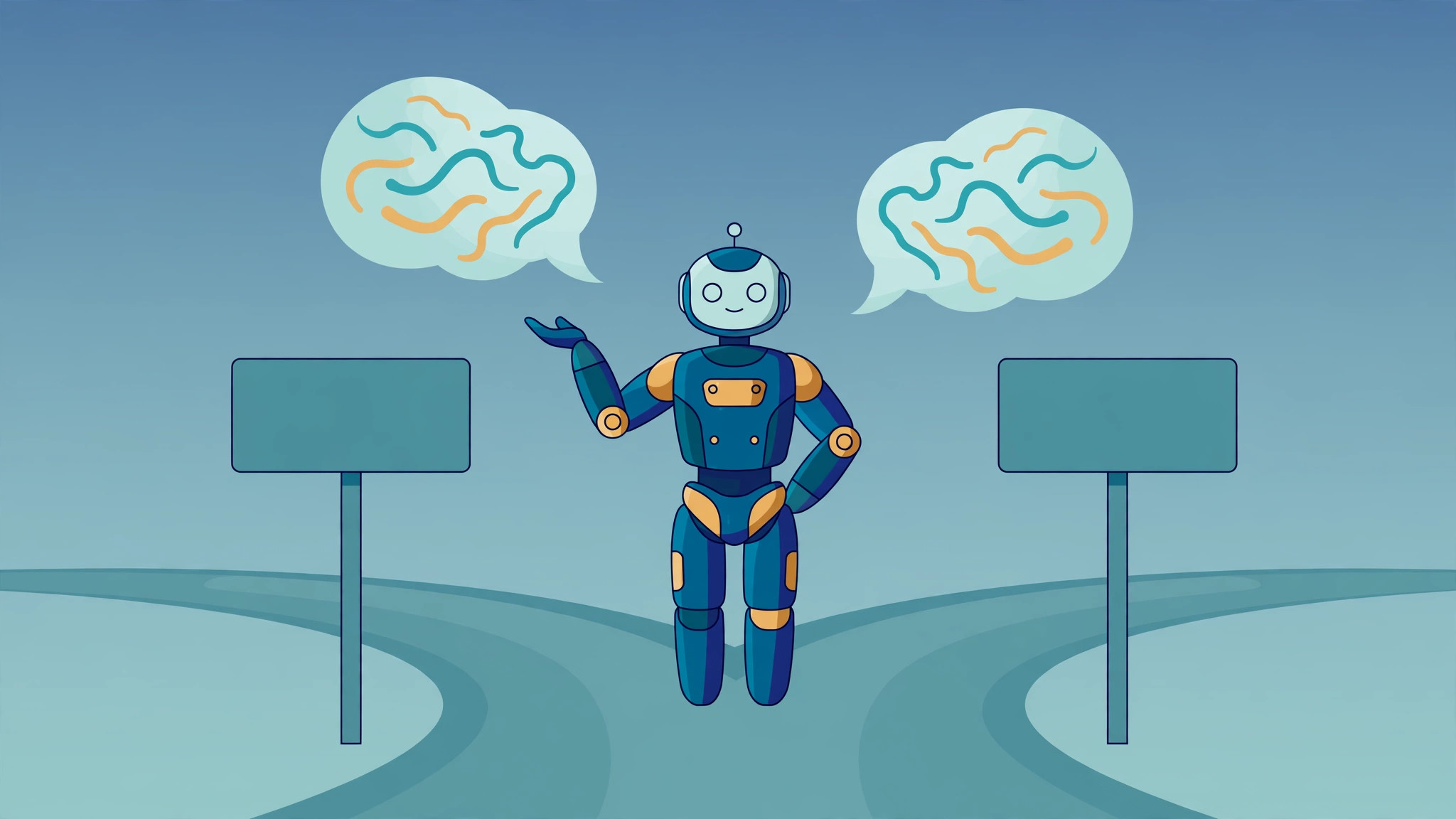
Ask ChatGPT whether you should take the job, buy the laptop, or learn Rust, and you will often get a long, careful reply that commits to nothing. One paragraph argues yes, the next argues no, and the conclusion lands somewhere in the middle: it depends on your situation. The answer reads like it was written by a committee that was afraid of being wrong.
This is not your prompt failing. Hedging is trained into modern chatbots, and it comes from the same machinery that makes them polite, safe, and agreeable. You cannot switch it off entirely, but you can push a model toward a real decision — by changing what you ask it to produce, not by asking it more politely to be direct.
Once you start looking, hedged answers fall into a few repeatable patterns. Spotting the pattern tells you which fix to reach for.
The both-sides essay. The model lists the case for and the case against in equal detail, then refuses to weigh them. You asked for a verdict and got a debate transcript.
The "it depends" stall. The answer dissolves into variables — your budget, your goals, your risk tolerance — without ever saying which variable matters most, or what it would pick under a stated set of assumptions.
The disclaimer drift. A short, useful answer is buried under caveats, restated cautions, and offers to elaborate. The model keeps talking after it has already answered, because continuing to qualify feels safer than stopping.
Users on LINUX DO, China's large developer forum, have been swapping notes on exactly this frustration: the sense that the longer you use a chatbot, the more its answers feel like liability paperwork. The complaint is not that the model is wrong. It is that the model will not say anything firm enough to be wrong about.
The main reason is in the training. Chatbots are fine-tuned with reinforcement learning from human feedback (RLHF): human raters rank candidate answers, and the model learns to produce the kind of answer raters tend to approve. Anthropic's 2023 research paper "Towards Understanding Sycophancy in Language Models" showed the side effect clearly — models trained this way systematically tilt their answers toward what the user seems to believe, admit mistakes when challenged even when they were right, and mirror the user's errors. Agreement feels helpful to raters, so agreement gets rewarded.
Safety training adds a second layer. A model that refuses to take a firm position on a medical, legal, or financial question is less likely to cause harm than one that bluffs with confidence. So models learn to qualify, and that qualifying habit leaks into questions where no safety issue exists at all — like which laptop to buy.
OpenAI's own rulebook points in the same direction, and also hints at the intended fix. Its Model Spec, updated on October 29, 2026, organizes desired model behavior around five values, including honesty and transparency: the model should represent what it knows, what it inferred, and how sure it is, truthfully. It also says style should follow what the individual user prefers, rather than a fixed house tone. OpenAI is candid that current models do not yet fully live up to that document — which is exactly why users still have to fight the hedging themselves.
Not every hedge is a defect, and stripping them all away would make answers worse, not better. A hedge is doing real work when:
The goal is not zero hedging. It is hedging in the right place: uncertainty stated once, up front, and then a decision anyway. "I don't have your budget, so assuming a mid-range budget, buy this one" is useful. Three paragraphs of "on the other hand" is not.
The most reliable trick is to stop asking open-ended questions and start asking for a decision-shaped output. Each of these reframes the request so that a both-sides essay no longer fits the format:
| Technique | Example prompt | When it works best |
|---|---|---|
| Lead with the verdict | "Give me your single recommendation first, then the reasons." | Any either/or choice |
| Force a ranking | "Rank these three options best to worst, with one line each on why." | Shortlists |
| Assume the missing facts | "Assume a $1,000 budget and a two-week deadline. What would you pick?" | "It depends" stalls |
| Demand a confidence level | "State your answer, then your confidence in it as a percentage." | Factual questions |
| Ask for the tiebreaker | "What single factor should decide this for someone in my position?" | Trade-off questions |
| Ban the format | "No pros-and-cons list. One recommendation and its biggest risk." | Repeat offenders |
Two details matter. First, put the constraint in the same message as the question — a follow-up like "just pick one" after a hedged answer works, but it costs you a round trip and the model often just re-hedges more briefly. Second, give the model permission to be wrong: "I will check this myself; I need your best judgment, not a guaranteed answer" measurably lowers the model's urge to cover itself, because you have taken responsibility for verification.
This is also why the folk tests users build for catching model degradation — like the world-map drawing test — work the way they do: they replace an open-ended chat with a task that has a checkable output, and there is nowhere for a hedge to hide.
If you find yourself typing "be direct" into every chat, stop and put it in the settings instead. ChatGPT's custom instructions are standing rules the model considers in every response. According to OpenAI's help center, they are available on all plans, on web, desktop, iOS, and Android.
On web or desktop, open Settings, choose Personalization, make sure Enable customization is on, and write in the Custom Instructions field. On iOS or Android, the same setting lives under Settings and then Customize ChatGPT. Free and Go users can save up to 1,500 characters; Plus, Pro, Business, Enterprise, and Education users can save up to 5,000.
A good set for directness looks like this:
Give a direct answer first, then supporting detail. No pros-and-cons
lists unless I ask for one. If you are uncertain, say so in one sentence
and give your best judgment anyway. Do not end with offers of further help.
Keep it short and behavioral — what to do, not what to be. Vague traits like "be smart" do nothing; formats like "answer first, reasons second" do. Note one honest limit from OpenAI itself: custom instructions are guidance, not a guarantee, and the model will not always follow them perfectly.
Forum users report, and this matches how the training works, that prompt tricks have a ceiling. As discussed on LINUX DO, some users find that persistent instruction tweaks help noticeably, while others report that on long, multi-step tasks the model's cautious base style gradually reasserts itself. That is the expected shape of the problem: a prompt is a nudge on top of training, not a replacement for it.
Two other approaches are weaker than they look. Raising the temperature in an API setting makes output more varied, not more decisive — randomness is not conviction. And arguing with the model ("you're wrong, just admit it") mostly triggers the sycophancy reflex documented in Anthropic's research: the model apologizes and agrees, which feels like progress and teaches you nothing. That apology loop is a close cousin of hedging, and it has its own failure mode in coding agents, where the model says sorry and changes a correct answer into an incorrect one.
Before your next chat, run through this:
ChatGPT hedges because hedging was, for a long time, the safest way to earn a human rater's approval. Until training changes, the fix sits on your side of the keyboard: ask for decisions in formats that cannot be hedged, give the model the facts it needs to decide, and treat the first sentence of the answer as the answer — because that is the part the model was trained to bury.